
Zoning Districts and Codes
Code Studio Inc:
urban design internship
Fall 24' Internship: Zoning codes & regulations
Code Studio Inc: Urban design intern
Team: Mrunmayee Pawar, Bertrand Bahizi
Guide: Christy Dodson, René Biberstein
Contributions: Zoning analysis and compliance, graphic representation of guidelines, rules of interpretation and coding, research and data compilation, document layout and formatting
As an Urban Design Intern at the Code Studio in Atlanta, I contributed to enhancing city planning initiatives by analyzing zoning codes for rezoning and recoding opportunities. My role involved graphically representing zoning guidelines and preparing visuals to support planning and code work, including interpreting complex rules and presenting them clearly. I conducted in-depth internet research to inform planning strategies and contributed to the creation of well-structured layouts and formats for plan and code documents. I also collaborated with team members to refine concepts and ensure alignment with urban design objectives, contributing to cohesive project outcomes. Through these efforts, I developed a keen understanding of urban planning processes, honed my skills in research, design, and document preparation, and gained valuable experience in balancing technical precision with creative problem-solving.
Zoning Districts: General Development Codes
unit types

Means a building containing 4 or more dwelling units which are rented or owned by the occupants and which have a common entrance from the street level and the occupants of which have the right to use in common, hallways, stairs, and/or elevators and yards but does not include any other dwelling defined herein.
Means a building containing 4 or more dwelling units which are rented or owned by the occupants and which have a common entrance from the street level and the occupants of which have the right to use in common, hallways, stairs, and/or elevators and yards but does not include any other dwelling defined herein.
apartment dwelling

Means a building that is divided vertically into 3 or more dwelling units, each of which has independent entrances to a front and rear yard.
Means a building that is divided vertically into 3 or more dwelling units, each of which has independent entrances to a front and rear yard.
townhouse dwelling

Means a building containing only one primary dwelling unit exclusive of any accessory dwelling unit.
Means a building containing only one primary dwelling unit exclusive of any accessory dwelling unit.
detached townhouse

Means a building divided vertically into two dwelling units above and below grade, each such dwelling unit having an independent entrance from outside the building.
Means a building divided vertically into two dwelling units above and below grade, each such dwelling unit having an independent entrance from outside the building.
semi-detached townhouse

Means a building that is divided horizontally above grade into 2 dwelling units, each of which has an independent entrance either directly or through a common vestibule.
Means a building that is divided horizontally above grade into 2 dwelling units, each of which has an independent entrance either directly or through a common vestibule.
duplex dwelling

Means a building that is divided horizontally into 3 dwelling units, each of which has an independent entrance either directly or through a common vestibule.
Means a building that is divided horizontally into 3 dwelling units, each of which has an independent entrance either directly or through a common vestibule.
triplex dwelling

Means a building that is divided vertically, with no common entrance, into 4 separate dwelling units, each of which has 2 common walls.
Means a building that is divided vertically, with no common entrance, into 4 separate dwelling units, each of which has 2 common walls.
quadruplex dwelling-
vertical

Means a building that is divided horizontally, with no common entrance, into 4 separate dwelling units, each of which has 2 common walls.
Means a building that is divided horizontally, with no common entrance, into 4 separate dwelling units, each of which has 2 common walls.
quadruplex dwelling-
horizontal

Means a building containing a minimum of 6 and not more than 20 dwelling units that is divided by common walls including a common rear wall without a rear yard setback, and where each dwelling unit has an independent entrance to the dwelling unit from the outside which is accessed through the front yard or exterior side yard.
Means a building containing a minimum of 6 and not more than 20 dwelling units that is divided by common walls including a common rear wall without a rear yard setback, and where each dwelling unit has an independent entrance to the dwelling unit from the outside which is accessed through the front yard or exterior side yard.
back-to-back townhouses

Means a residential building containing a minimum of four and a maximum of twenty units, provided that: i) not more than half of all dwelling units shall be on the ground floor; ii) dwelling units shall be fully attached to adjoining units; and, iii) access to each second level unit shall be from an independent interior or exterior stairway.
Means a residential building containing a minimum of four and a maximum of twenty units, provided that: i) not more than half of all dwelling units shall be on the ground floor; ii) dwelling units shall be fully attached to adjoining units; and, iii) access to each second level unit shall be from an independent interior or exterior stairway.
stacked townhouses
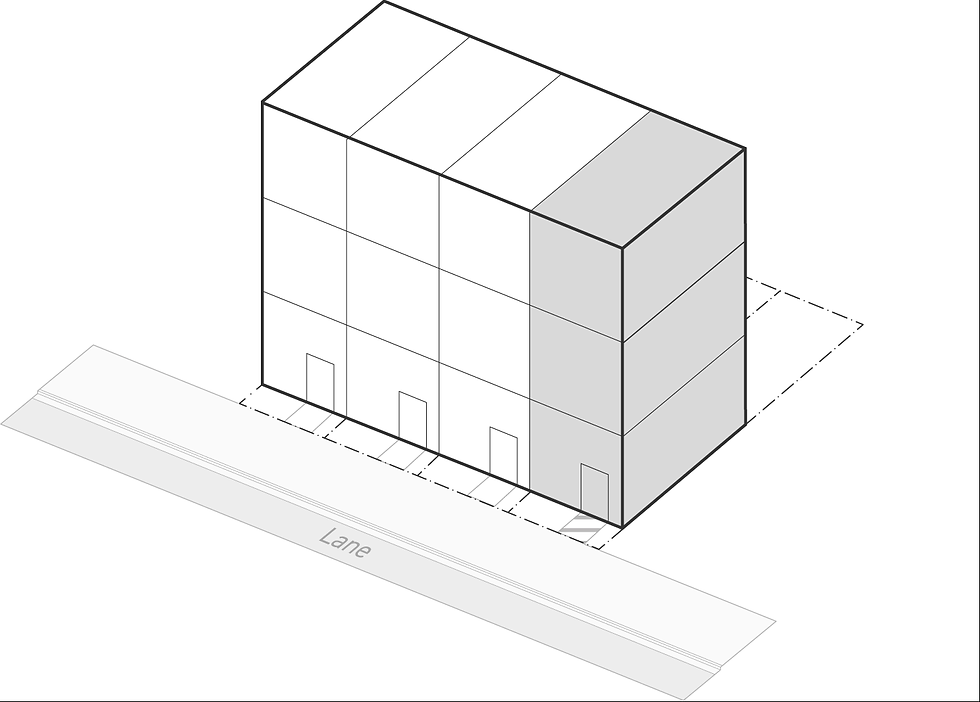
Means a dwelling with a garage at the back of the property, accessed by an alleyway rather than a driveway at the front.
Means a dwelling with a garage at the back of the property, accessed by an alleyway rather than a driveway at the front.
rear-lane townhouses

Means a residential use building containing three or more attached principal dwelling units divided vertically, and where all dwelling units are located on one lot and accessed from a private street.
Means a residential use building containing three or more attached principal dwelling units divided vertically, and where all dwelling units are located on one lot and accessed from a private street.
block townhouse dwelling
massing

tower

tower/building base

tower floor-plate

tower stepback

building length

Portions of a building facade, when projected parallel to a street lot line, with no permanent structure located between the building facade and the street lot line.
Portions of a building facade, when projected parallel to a street lot line, with no permanent structure located between the building facade and the street lot line.
building front facade

building articulation

light well

The horizontal depth of a building that must contain active uses. To help minimize the impact of dead space on the public realm and to promote a comfortable, safe, engaging and attractive built environment with active uses along the public realm.
The horizontal depth of a building that must contain active uses. To help minimize the impact of dead space on the public realm and to promote a comfortable, safe, engaging and attractive built environment with active uses along the public realm.
active depth

Means the gross floor area of all buildings on a lot divided by the lot area.
Means the gross floor area of all buildings on a lot divided by the lot area.
FSI

inset balcony

juliette balcony
general provisions

A front lot line shall be defined as follows: i) In the case of an interior lot, shall be the lot line abutting a street. ii) In the case of a corner lot, shall be the shorter lot line that abuts a street. iii) In the case of a corner lot with two street lines of equal length, shall be the lot line which abuts a Regional Road. In the case that both abutting streets are under the same jurisdiction or are of the same width, the Municipality may designate either street line as the front lot line.
A front lot line shall be defined as follows: i) In the case of an interior lot, shall be the lot line abutting a street. ii) In the case of a corner lot, shall be the shorter lot line that abuts a street. iii) In the case of a corner lot with two street lines of equal length, shall be the lot line which abuts a Regional Road. In the case that both abutting streets are under the same jurisdiction or are of the same width, the Municipality may designate either street line as the front lot line.
front lot line

Means a yard extending across the full width of a lot between the front lot line and the nearest wall of the principal building or structure on the lot.
Means a yard extending across the full width of a lot between the front lot line and the nearest wall of the principal building or structure on the lot.
front yard

Means the lot line or intersection of the side lot lines, opposite to, and most distant from, the front lot line.
Means the lot line or intersection of the side lot lines, opposite to, and most distant from, the front lot line.
rear lot line

Means a yard extending across the full width of a lot between the rear lot line and the nearest wall of the principal building or structure on the lot.
Means a yard extending across the full width of a lot between the rear lot line and the nearest wall of the principal building or structure on the lot.
rear yard

Means a lot line, other than a front or rear lot line.
Means a lot line, other than a front or rear lot line.
interior side-lot line

Means a yard other than an exterior side yard, extending from the front yard to the rear yard between the interior side lot line and the nearest wall of the principal building or structure on the lot.
Means a yard other than an exterior side yard, extending from the front yard to the rear yard between the interior side lot line and the nearest wall of the principal building or structure on the lot.
interior side yard

Means a lot line, other than a front or rear lot line. In the case of a corner lot, the lot line that abuts a street shall be identified as the exterior side lot line.
Means a lot line, other than a front or rear lot line. In the case of a corner lot, the lot line that abuts a street shall be identified as the exterior side lot line.
exterior side-lot line

Means the yard of a corner lot extending from the Front Yard to the rear yard between the exterior side lot line and the nearest main wall of the principal building or structure on the lot.
Means the yard of a corner lot extending from the Front Yard to the rear yard between the exterior side lot line and the nearest main wall of the principal building or structure on the lot.
exterior side yard

A through lot is a lot that has frontage on more than one street, but is not a corner lot.
A through lot is a lot that has frontage on more than one street, but is not a corner lot.
through lot

Means a lot situated at the intersection of and abutting onto two or more streets or two sections of the same street, provided that the angle of intersection of such street(s) is not more than one hundred and thirty-five degrees.
Means a lot situated at the intersection of and abutting onto two or more streets or two sections of the same street, provided that the angle of intersection of such street(s) is not more than one hundred and thirty-five degrees.
corner lot

Means a lot other than a corner lot.
Means a lot other than a corner lot.
interior lot

A daylighting triangle refers to a triangular area at a street intersection, typically at a corner lot, where there are no obstructions to visibility, allowing drivers to clearly see oncoming traffic and pedestrians due to the open space created by the design; essentially, it's a designated area free of buildings or structures to ensure good sight lines at an intersection.
A daylighting triangle refers to a triangular area at a street intersection, typically at a corner lot, where there are no obstructions to visibility, allowing drivers to clearly see oncoming traffic and pedestrians due to the open space created by the design; essentially, it's a designated area free of buildings or structures to ensure good sight lines at an intersection.
daylighting triangle
building height

Means that portion of a building that is underground, which has more than one third of its height above established grade but where the height above established grade does not exceed 1.8 metres.
Means that portion of a building that is underground, which has more than one third of its height above established grade but where the height above established grade does not exceed 1.8 metres.
basement

Means that portion of a building which is partly underground, but which has more than 50% of the floor area not greater than 0.6 metres below established grade, and which has an entrance or exit at grade level.
Means that portion of a building which is partly underground, but which has more than 50% of the floor area not greater than 0.6 metres below established grade, and which has an entrance or exit at grade level.
walkout basement

Means a storey or any part of a storey which has less than one third of its height above the established grade.
Means a storey or any part of a storey which has less than one third of its height above the established grade.
cellar

low-rise:
4 storeys or less

Means the vertical distance measured between the average established grade and any of the following: i) on a flat roof, the highest point of the roof surface or the parapet, whichever is the greater; ii) the deckline of a mansard roof; iii) on a gabled, hip, gambrel or any other type of pitched roof, the mean distance between the eaves and ridge of a roof; or iv) the highest point of a structure without a roof.
Means the vertical distance measured between the average established grade and any of the following: i) on a flat roof, the highest point of the roof surface or the parapet, whichever is the greater; ii) the deckline of a mansard roof; iii) on a gabled, hip, gambrel or any other type of pitched roof, the mean distance between the eaves and ridge of a roof; or iv) the highest point of a structure without a roof.
height

The floor-to-floor height of the story of a building having its finished floor elevation nearest to the finished ground surface.
The floor-to-floor height of the story of a building having its finished floor elevation nearest to the finished ground surface.
ground floor height

mid-rise:
5 storeys to 8 storeys

Means a level of a building located between the surface of a floor and the ceiling or roof immediately above it, and includes a mezzanine but does not include a basement or cellar. Any portion of a building partly below grade level shall be deemed a Storey where its ceiling is at least 1.8 metres above established grade.
Means a level of a building located between the surface of a floor and the ceiling or roof immediately above it, and includes a mezzanine but does not include a basement or cellar. Any portion of a building partly below grade level shall be deemed a Storey where its ceiling is at least 1.8 metres above established grade.
storey

high-rise:
9 storeys or higher
Neighborhood-Scale Districts: Atlanta Zoning 2.0
Intent Graphics for Neighborhood-scale district type for the Atlanta Zoning 2.0 Code


Neighborhood-Scale Form Districts are intended to accommodate lower intensity neighborhood areas with small to medium lot sizes and moderate lot coverage, and are generally in areas within walking distance of neighborhood-serving retail, service, and other commercial uses. The number of dwelling units allowed on each lot varies by Form District. Typically Neighborhood-Scale Form Districts are paired with Use Districts that primarily allow household living uses and some civic uses. Sometimes Neighborhood-Scale Form Districts are paired with Use Districts that allow neighborhood-serving commercial uses that are limited in size and extent.
Digital workflow + Software used:

Enscape
ArcGIS
Urban Footprint
AutoCAD
Photoshop
Illustrator
InDesign
Rhino 3D
SketchUp
Vray
Lumion
Rendering and post production
Drawing, editing, production, documentation
3D modelling
Analysis and Mapping